Copyright©Connectnow AI Technology Co.,Limited 2025. All rights reserved. Without the written permission of our company, no entity or individual shall arbitrarily extract and copy part or all of the content of this document, nor shall it be disseminated in any form.
Trademark Statement
[ConnectNow] (and other [ConnectNow] trademarks) are trademarks of Connectnow AI Technology Co.,Limited.
All other trademarks or registered trademarks mentioned in this document are owned by their respective owners.
Notice
The products, services, or features you have purchased shall be subject to the commercial contracts and terms of Connectnow AI Technology Co.,Limited. The products, services, or features described in this document, in whole or in part, may not be within the scope of your purchase or use. Unless otherwise stipulated in the contract, the company makes no express or implied statements or warranties regarding the content of this document.
Due to product version upgrades or other reasons, the content of this document will be updated irregularly. Unless otherwise agreed, this document is only provided as a usage guide, and all statements, information, and suggestions in this document do not constitute any express or implied warranties.
Connectnow AI Technology Co.,Limited
Address: Room 217, Building 5C, Shenzhen Software Industry Base, No. 11, 13, 15 Haitian 1st Road, Binhai Community, Yuehai Subdistrict, Nanshan District, Shenzhen, China
Website: ConnectNow - https://www.connectnowai.com
Customer service email: privacy@connectnowai.com
1.1. Scope
The ConnectNow (EU) AI Act Compliance Statement (hereinafter referred to as the “Statement”) applies to the situations where Connectnow AI Technology Co.,Limited (hereinafter referred to as “we”) provides ConnectNow products or services to users or customers (hereinafter referred to as “you”) located in the European Union, or where you provide services to consumers located in the European Union based on the ConnectNow products. This Statement aims to illustrate the compliance measures taken by the ConnectNow products to comply with the Artificial Intelligence Act (hereinafter referred to as the “AI Act”).
1.2. Basic definitions
• AI system means a machine-based system that is designed to operate with varying levels of autonomy and that may exhibit adaptiveness after deployment, and that, for explicit or implicit objectives, infers,from the input it receives, how to generate outputs such as predictions, content, recommendations, or decisions that can influence physical or virtual environments.
• General-purpose AI model means an AI model, including where such an AI model is trained with a large amount of data using self-supervision at scale, that displays significant generality and is capable of competently performing a wide range of distinct tasks regardless of the way the model is placed on the market and that can be integrated into a variety of downstream systems or applications, except AI models that are used for research, development or prototyping activities before they are placed on the market.
• Risk means the combination of the probability of an occurrence of harm and the severity of that harm.
• Training data means data used for training an AI system through fitting its learnable parameters.
• AI literacy means skills, knowledge and understanding that allow providers, deployers and affected persons, taking into account their respective rights and obligations in the context of this Act, to make an informed deployment of AI systems, as well as to gain awareness about the opportunities and risks of AI and possible harm it can cause.
The EU AI Act is the world’s first comprehensive law regulating artificial intelligence. It came into effect on August 1st, 2024. The relevant regulatory rules will be implemented in phases over the next three years, with the majority of the provisions set to take effect on August 2nd, 2026. The specific timeline is as follows: (1) Chapter I (Scope of Application, Definitions, and AI Literacy Provisions) and Chapter II (Unacceptable Risk Level AI Systems) shall apply from 2nd February 2025; (2) Chapter III Section 4 (Establishment of Relevant Regulatory and Supervisory Procedures by EU Member States), Chapter V (General-purpose AI Models), Chapter VII (EU AI Regulatory System and Institutions) and Chapter XII (Penalties) and Article 78 (Confidentiality Requirements for Regulatory Authorities) shall apply from 2nd August 2025, with the exception of Article 101 (Fines for Providers of General-purpose AI Models); (3) Article 6(1) (Classification Rules for High-risk AI Systems) and the corresponding obligations shall apply from 2nd August 2027.
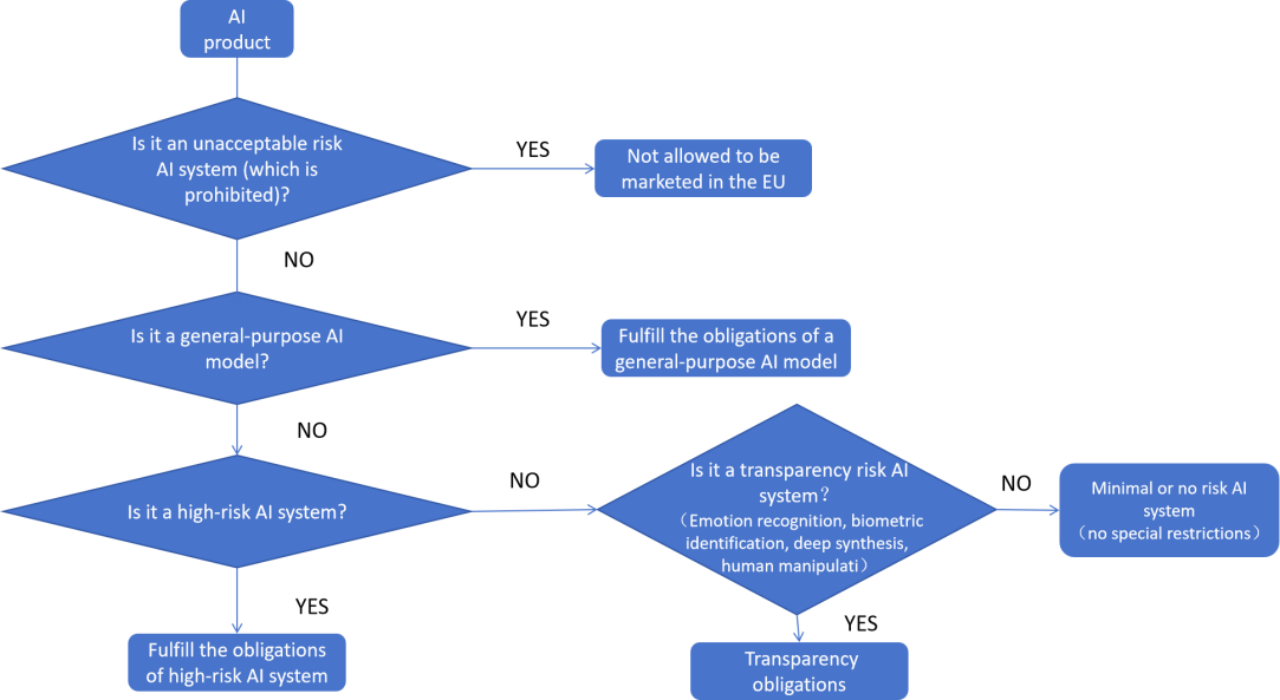
AI Act pioneers a “risk-based” regulatory model, which means that the regulatory rules are determined based on the potential harm AI technology may cause to individuals’ fundamental rights and society. The higher the risk, the stricter the regulatory rules will be. Specifically, the AI Act categorizes AI systems into four risk levels: unacceptable risk, high risk, transparency risk, and minimal or no risk. The obligations that AI systems are required to fulfill vary according to their risk levels. Generally speaking, the obligations that AI systems should fulfill are proportional to their risk levels. High-risk AI systems are required to fulfill the strictest obligations, while AI systems with unacceptable risk are directly prohibited from use. At the same time, the AI Act classifies the roles in the AI business chain mainly as providers, deployers, importers, distributors, and authorized representatives. For AI systems of different risk levels, each role in the business chain has different compliance obligations. In addition, the AI Act also focuses on the legal risks of general-purpose AI models, dividing them into those with systemic risk and those without systemic risk. General-purpose AI models are required to fulfill independent obligations, and those with systemic risk are required to fulfill additional obligations. Specifically, the regulatory logic of the AI Act for AI systems is shown in the figure below:

Figure 1 The Regulatory Approach of the AI Act
3.1 Brief Introduction to the AI Functions of ConnectNow
ConnectNow is an AI-powered intelligent customer service product. The AI functions involved in it include: AI audio-to-text transcription, AI summarization, RAG intelligent assistant, AI agent assistant, and AI quality inspection function. The specific overview of its AI functions is as follows:
• AI audio-to-text transcription: ConnectNow automatically converts the content of the call into text.
• AI summarization: ConnectNow generates summaries of key information based on the recorded audio text to help quickly understand customers’ intentions.
• RAG intelligent assistant: Based on retrieval augmented generation technology and an exclusive knowledge base, ConnectNow provides highly accurate interactive services, instantly retrieves information and generates relevant responses.
• AI Agent Assistant: ConnectNow provides auxiliary functions such as real-time translation, conversation summarization, and intelligent expansion for human customer service representatives.
• AI quality inspection: ConnectNow conducts quality control by analyzing call transcriptions and evaluate the performance of customer service representatives.
3.2 Explanation of the AI Risk Levels of ConnectNow
In accordance with the provisions of the AI Act, this statement clarifies the risk level to which ConnectNow products belong as follows:
a.ConnectNow does not belong to unacceptable risk AI systems
According to Article 5 of AI Act, prohibited AI practices involve usage scenarios that cause significant harm to individuals and others, such as AI technologies that subliminally manipulate individuals or groups.The AI functions of ConnectNow (such as AI audio-to-text transcription, AI intelligent summarization, RAG intelligent assistant, AI agent assistant, and AI intelligent quality inspection) are all used to improve the efficiency of corporate customer service. They do not involve the above-mentioned high-risk scenarios and do not involve the prohibited artificial intelligence practices stipulated in the AI Act.
b.ConnectNow does not belong to high-risk AI systems
Article 6, Annex 1 and Annex 3 of the AI Act clearly define the scope of high-risk AI systems, such as AI systems used in critical areas like healthcare, education, employment, law enforcement, and energy. As an enterprise-level intelligent customer service solution, ConnectNow does not belong to the category of high-risk AI systems.
c.ConnectNow does not belong to General-purpose AI models
Articles 53 to 55 of the AI Act impose additional regulatory requirements on General-purpose AI models (such as large language models like ChatGPT). The AI capabilities of ConnectNow are optimized for vertical scenarios and invoke third-party specialized models. It does not possess broad general-purpose applicability. Therefore, it’s not subject to the constraints of the relevant provisions.
d.ConnectNow belongs to limited risk AI systems
Since some functions of ConnectNow (such as intelligent summarization and AI assistant) are based on generative AI technology, according to Article 50 of the AI Act, ConnectNow is classified as a limited risk AI system. In this regard, the core risk that ConnectNow products need to focus on is transparency risk.
Given that ConnectNow is classified as a limited risk AI system, its core compliance obligations under the AI Act include transparency obligations, general compliance obligations (such as providing AI literacy), and addressing common risk issues in the AI field (such as the legality of training data sources). The following text will focus on three dimensions-transparency obligations, the legality of training data sources, and the company’s internal governance system-to elaborate on the compliance measures that have been implemented by ConnectNow.
4.1 Transparency Obligation
We have taken a series of measures to fulfill the transparency obligation, which specifically include:
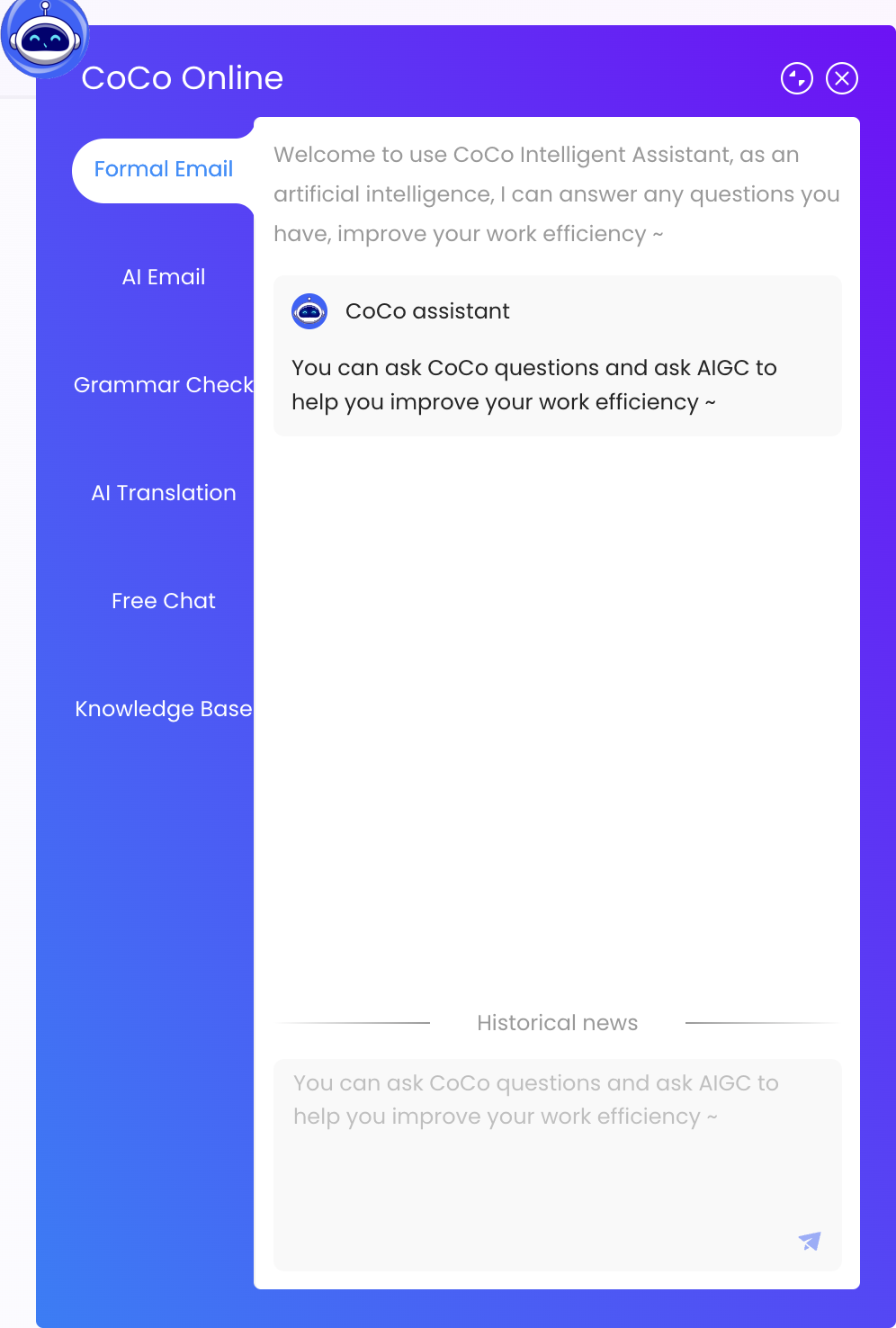
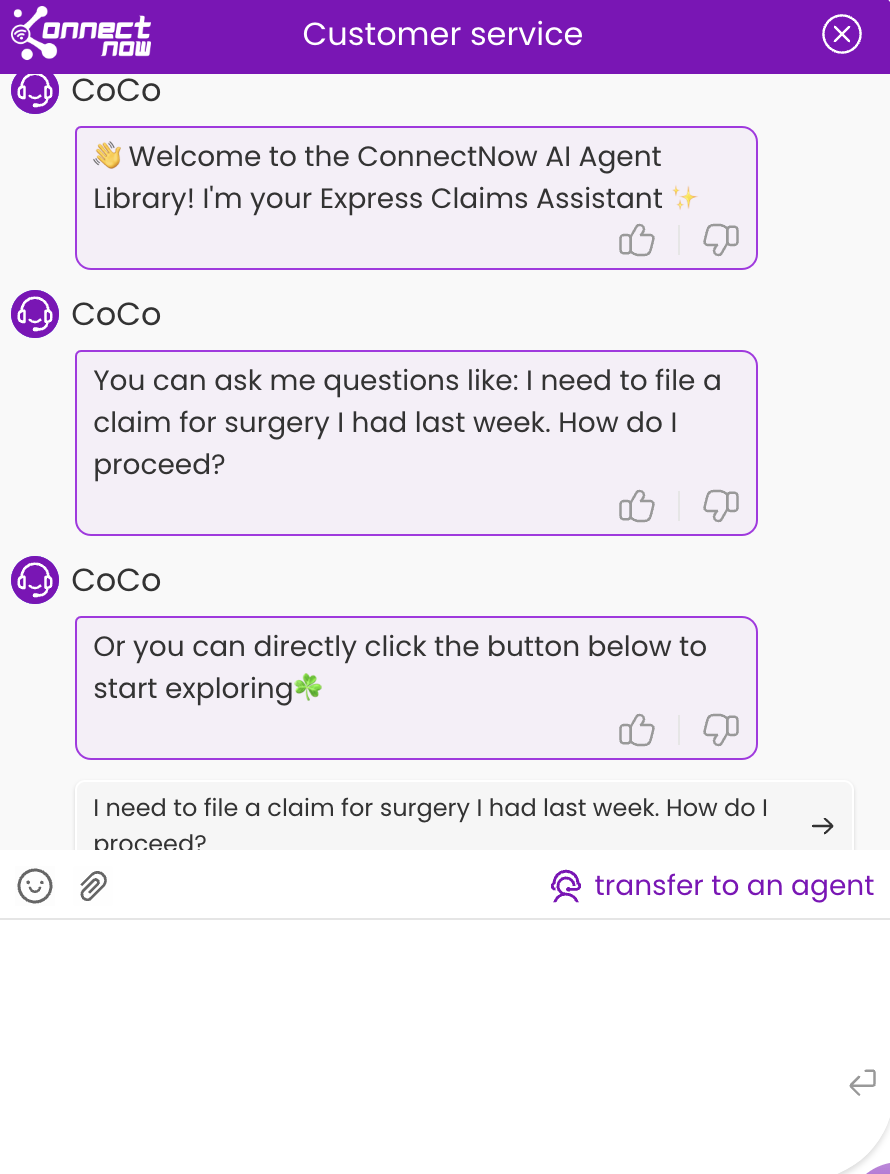
(1)Display on the AI function interface of the product that the service is generated by AI, as shown in the figure below:


(2)Draft and issue this statement to disclose to customers and end-users the AI functions, risk level, and sources of training data of the product.
4.2 Compliance Statement on the Sources of Training Data
Regarding the issue of training data, we clarify as follows:
(1)After connecting the large language model, we have not used training data to conduct targeted training on it.
(2)To make the content generated by the AI more in line with your work practices, we have provided you with a knowledge base upload function. You can upload content to the knowledge base on your own to optimize the model. However, it is necessary to prominently remind you that before uploading the content, you should ensure that the relevant content does not infringe upon the legitimate rights and interests of any third party.
4.2 Compliance Statement on the Sources of Training Data
Regarding the internal governance of the company for AI compliance, we have taken the following measures:
• We adopt a combined internal-external approach to conduct compliance assessments on our current ConnectNow products, continuously implementing and iterating corrective measures. We have established a systematic AI compliance governance system and used an integrated internal-external approach to continuously promote the compliance optimization of ConnectNow products. Internally, a special working group composed of the legal, R&D, and product departments conducts compliance reviews of product functions in accordance with the requirements of the AI Act, with a focus on key dimensions such as the risk level of AI systems, data processing procedures, and algorithm transparency. Externally, we have engaged professional law firms and maintained close cooperation with them to ensure the professionalism and objectivity of the assessment.
• We focus on the cybersecurity and data security of AI models and systems, and ensure data compliance and data governance throughout the entire lifecycle of AI systems. Our affiliate company already obtained the ISO 27000 certification and we have established and implemented a number of cybersecurity and data security management systems, including the information security management system and the data security management system.
• We conduct AI literacy education within the company. We regularly organize technical and related training in the field of AI to enhance employees’ professional capabilities, ensuring that R&D personnel and others understand the risks and usage regulations of AI technology. We also keep corresponding training records and photos to comply with the AI Act’s provisions on AI literacy.
We deeply understand the importance of security and compliance in the application of AI technology. We attach great importance to the legal requirements of the AI Act and regard them as important guidelines for product development and operations, so as to ensure that the development and application of AI products comply with the strict regulations of the AI Act.
To ensure full compliance of our business in the European Union, we will continue to keep abreast of the dynamic updates of AI Act and related practice guidelines, and promptly integrate them into our internal rules and regulations as well as the development and application of our products.
Complying with the AI Act and relevant legal requirements is a long-term and systematic endeavor that involves multiple dimensions, including technology, management, and law. We are committed to continuously enhancing our capabilities in the future to meet the requirements of relevant laws and regulations, and to provide our customers with safe, reliable, and compliant AI products and services.
This statement is for reference only. It has no legal effect and does not constitute legal advice. Please carefully evaluate the scenarios in which you use our AI products based on your own actual situation, and ensure strict compliance with all the provisions of the AI Act when using these products in the European Union region.
| Version | Date | Description |
|---|---|---|
| 1.0 | 2025/04/27 | Initial Release |